
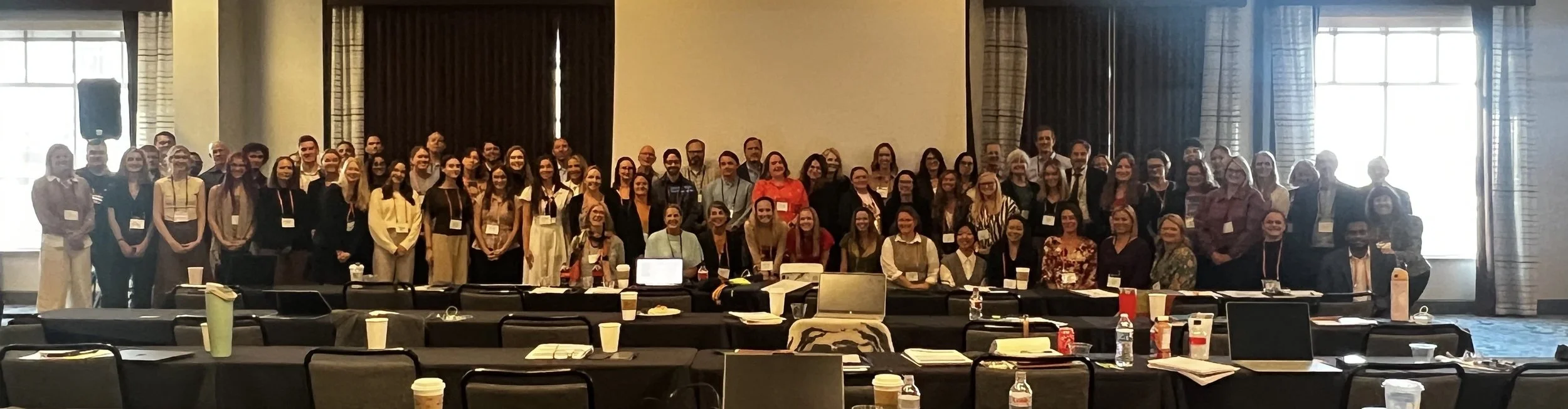
Love Never Sinks was proud to participate in the 2026 CombinedBrain Summit, connecting with researchers, clinicians, and fellow rare disease advocacy organizations. Together, we explored new ideas, shared knowledge, and discussed opportunities to advance research and improve the future for families living with rare neurological conditions. Every connection brings us one step closer to answers. 💙
SEE THE RARE. SHARE THE DATA. CHANGE THE FUTURE.
Connecting families, researchers, and new approaches to accelerate progress in rare neurological diseases
Love Never Sinks was excited to participate in the 2026 CombinedBrain Summit, bringing together patient advocacy organizations, researchers, physicians, biotechnology companies, and industry leaders working to advance treatments for rare neurological and genetic conditions.
For families living with a rare disease like Lesch-Nyhan Disease (LND), research can sometimes feel slow, complicated, and far removed from everyday life. But meetings like this are important because they bring people together to share ideas, identify opportunities, and explore new ways to move research forward.
One of the biggest messages from the summit was that we don't have to approach every rare disease as an isolated problem. Different diseases may share biological pathways, symptoms, or mechanisms. By working together and sharing knowledge, we may discover opportunities that would otherwise be missed.
Here are some of the important developments and discussions we want our community to know about.
1. Looking Toward the Future: A Center of Excellence for Rare Neurogenetic Conditions
One of the exciting discussions at the summit focused on the possibility of developing a Translational Hub and Center of Excellence through CombinedBrain, with Phoenix Children's as a potential clinical partner.
The vision is to create a more coordinated, patient-centered approach to caring for children with rare neurogenetic conditions while strengthening the connections between families, physicians, and researchers.
The proposed model would bring together specialists such as neurologists, physical therapists, cardiologists, geneticists, and other professionals to improve communication, share expertise, and help families navigate complex medical needs.
Another idea discussed was a "hub and spoke" model. This would allow specialized centers to share their expertise with physicians and families in other communities, extending knowledge and resources beyond one geographic location.
An especially important part of this vision is recognizing that families are experts in their loved one's daily experiences. Their knowledge and observations need to be part of the conversation when developing care strategies and research priorities.
For Love Never Sinks, these conversations are particularly meaningful. We see opportunities like this as a way to strengthen collaboration, build research readiness, and connect the rare disease community with the expertise and resources needed to move science forward.
Importantly, this type of collaborative hub is not intended to replace or compete with NIH and other University research initiatives. Rather, it represents another opportunity to build relationships, develop resources, and strengthen the research foundation needed to advance rare disease science. Our long-term goal remains to see continued advancement of Lesch-Nyhan Disease research through the NIH and other leading research institutions. Lesch-Nyhan Natural History Study at the NIH — Love Never Sinks
The more connected our families, clinicians, and researchers become, the better positioned we will be to support meaningful discoveries and future treatment opportunities.
2. Better Data Can Lead to Better Research
A major theme throughout the summit was the importance of collecting and connecting different types of patient data.
You may hear terms like patient registry, natural history study, biomarkers, and multi-omics. These can sound complicated, but each helps researchers understand a different part of a disease.
Here is what they mean:
Patient Registries: Collect information directly from individuals and families about diagnoses, symptoms, treatments, and everyday experiences. CoRDS Disease Registry — Love Never Sinks
Natural History Studies: Follow individuals over time to understand how a disease develops and changes. This information helps researchers identify patterns and determine whether a potential treatment is making a difference. Lesch-Nyhan Natural History Study at the NIH — Love Never Sinks
Genetic Testing: Helps identify the underlying genetic changes responsible for a condition.
Biomarkers: Measurable signs in the body that may help researchers understand disease activity or determine whether a treatment is working.
Electronic Health Records: Provide information from medical visits, physician notes, laboratory results, and treatment decisions.
No single source tells the whole story. When researchers can connect these different types of information, they gain a much more complete picture of a disease.
For Lesch-Nyhan Disease, this reinforces why family participation in registries, natural history studies, and research initiatives is so important.
The information families share today may help researchers develop the treatments of tomorrow.
Lesch-Nyhan Research Participation & Clinical Studies — Love Never Sinks
3. Could Existing Medications Help Treat Rare Diseases?
One of the most interesting areas discussed was something called drug repurposing.
Drug repurposing means finding new uses for medications that have already been developed or approved to treat other conditions.
Instead of starting from the beginning to create an entirely new medication, researchers investigate whether an existing drug might affect a biological pathway involved in another disease.
Several examples were shared:
Researchers have explored using medications originally developed for cancer or other conditions to address rare neurological disorders.
Sirolimus, a medication used for other medical purposes, became an established treatment approach for certain patients with ALPS after research demonstrated its benefits.
Other research teams are investigating medications for rare genetic conditions using laboratory studies and carefully designed clinical trials.
The summit also highlighted an important caution: computer predictions and artificial intelligence can help researchers identify promising medications, but those predictions must be tested through proper scientific studies and clinical trials.
Finding a possible treatment is only the beginning. Researchers must also establish safety, appropriate dosing, effectiveness, and whether patients can realistically access the medication.
This area of research is particularly interesting for rare diseases because it may offer opportunities to move toward potential treatments without always having to develop an entirely new drug.
4. New Technology Is Changing How Researchers Look for Treatments
Another exciting discussion focused on new technologies that help researchers identify connections between genes, proteins, diseases, and medications.
Several organizations presented innovative approaches.
Every Cure – Finding New Connections
Every Cure uses large amounts of biological information to identify medications that may have potential benefits for diseases they were not originally designed to treat.
Unravel – Molecular twin
One approach uses a patient's RNA information to create what researchers describe as a "molecular twin." This helps scientists explore how different medications might interact with that individual's biology.
Model Therapeutics – Looking Across Diseases
Rather than studying one disease at a time, Model Therapeutics is exploring ways to group diseases that share similar biological features.
This could help researchers identify medications that may work across multiple conditions with related biological pathways.
Forma Health – From the Patients Voice to a Living Data Set
Forma Health provides a patient-centered digital platform that captures real-time health information, daily observations, videos, and wearable data between clinical visits, helping researchers build more complete, longitudinal datasets and identify patterns that can advance clinical research and treatment development.
AI and Knowledge Graphs – Connecting the Dots
Researchers are also using artificial intelligence and large databases to identify relationships between genes, proteins, symptoms, and medications.
These tools can help generate new research questions and identify possibilities that might otherwise take years to uncover.
For the rare disease community, these developments offer another reason to support collaboration across organizations. A discovery made while studying one condition could potentially benefit another.
5. Biobanking: Building Resources for Future Research
Another important topic was the development of shared biological sample repositories, often called biobanks.
A biobank collects and stores biological samples, such as blood, saliva, and other specimens, so researchers can study diseases at a deeper level.
These samples can help scientists examine:
DNA and genetic changes.
RNA, which helps show how genes are being used.
Proteins and how they function in the body.
Biological differences between individuals with the same diagnosis.
The summit discussed ways to make sample collection easier for families, including collection opportunities at conferences, home collection kits, and physician-assisted collection.
An important part of this initiative is that patient advocacy organizations have a role in overseeing how samples are distributed and used.
For families, this means there may be opportunities to contribute to research without always needing to travel to a major research center.
International sample collection does have additional regulatory and logistical requirements, so opportunities will depend on the location and the research protocols involved.
6. Why Natural History Studies Matter
Another important message was that collecting information once is not enough.
Researchers need to understand how a disease changes over months and years.
This is called a natural history study.
For example, in Lesch-Nyhan Disease, researchers need to understand how symptoms, movement, behavior, communication, development, and other aspects of health change throughout a person's life.
This information helps researchers:
Understand how the disease progresses.
Identify which symptoms may be most important to measure.
Determine the best time to introduce a potential treatment.
Establish a baseline to compare against when evaluating a new therapy.
Develop meaningful measurements for future clinical trials.
Without this information, it can be difficult to determine whether a new treatment is truly making a difference.
This is why participation in research studies is so valuable, including for individuals with different forms of Lesch-Nyhan Disease.
Lesch-Nyhan Natural History Study at the NIH — Love Never Sinks
7. What Does This Mean for Lesch-Nyhan Disease?
You may be wondering how all of this connects specifically to Lesch-Nyhan Disease.
While the summit did not announce a new treatment or clinical trial for LND, many of the discussions directly relate to the challenges we face as a rare disease community.
We need better ways to understand the disease, connect biological information, identify potential treatment opportunities, and prepare for future clinical trials.
The ideas discussed at the summit reinforce several priorities:
Research Readiness: Building the data, resources, and scientific relationships needed to support future research.
Family Participation: Encouraging families to participate in registries, natural history studies, and research opportunities.
Collaboration: Connecting researchers who may be studying similar biological pathways, even when they are working on different diseases.
Treatment Exploration: Keeping an open mind about new technologies, drug repurposing, and innovative research approaches.
Better Outcome Measures: Identifying meaningful ways to measure changes in symptoms and quality of life.
We also recognize that discoveries alone are not enough. Families need access to specialists, treatments, insurance coverage, and clinical trials. The summit highlighted many of the financial, regulatory, and practical barriers that still stand between research discoveries and the people who need them.
Lesch-Nyhan Research Participation & Clinical Studies — Love Never Sinks
Moving Forward Together
One of the most encouraging takeaways from the CombinedBrain Summit was the willingness of organizations, researchers, and industry partners to work together.
Rare diseases may be individually uncommon, but the challenges families face often overlap. By sharing data, resources, and scientific knowledge, we can create opportunities that might not be possible working independently.
At Love Never Sinks, our commitment remains focused on supporting families, building community, and advancing Research Readiness.
We will continue to strengthen relationships with researchers, explore opportunities for collaboration, and help connect families with meaningful research opportunities.
Progress doesn't always begin with a treatment announcement. Sometimes it begins with a conversation, a shared dataset, a biological sample, or a researcher recognizing a connection that no one had seen before.
Every person with Lesch-Nyhan has a story. Every family's contribution matters. And every step toward better understanding brings us closer to a future with more answers and more hope.
💙 SEE THE RARE. SHARE THE DATA. CHANGE THE FUTURE.
Thank you to CombinedBrain and all the researchers, clinicians, advocacy organizations, and families working together to advance research for rare neurological diseases. COMBINEDBrain - Home

